CONSIDER THIS A DIVORCE!
Wall Street and Main Street Have Officially Gone Their Separate Ways

At a time when the adage attributed to Vladimir Lenin or Josef Goebbels: “lie enough and it becomes the truth” seems rife, everyday Americans are not being fooled.
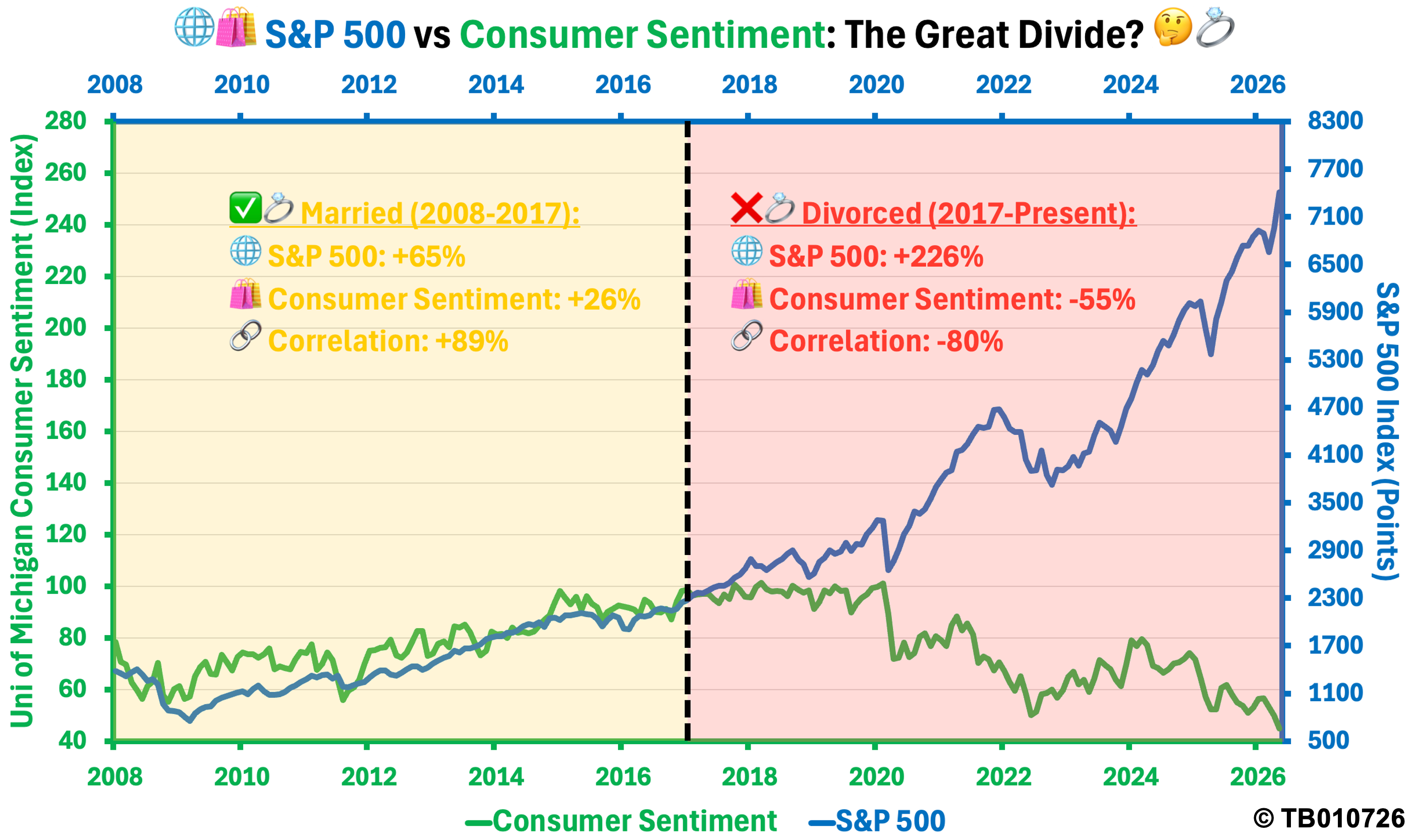
A swathe of the general population are becoming increasingly pessimistic about their financial futures - as indicated by the most recent University of Michigan Consumer Sentiment Survey which came in at just 44.8 points in May.
Consumer confidence is now weaker than it was during the depths of the 2008-09 Global Financial Crisis (GFC) - the worst economic downturn since the Great Depression.
Yet investors appear to be living an entirely different reality.
The S&P 500 Is At Record Highs
While consumer confidence sits near historic lows, the S&P 500 continues to trade close to all-time highs at 7,500 points.
That’s more than 11x higher than the low of 666 points reached during 2009.
2008-17: When Fundamentals Still Mattered
For nearly a decade after the 2008-09 GFC, the relationship between Main Street and Wall Street made perfect sense:
Consumer confidence rose.
Consumers spent more.
Corporate earnings increased.
The S&P 500 climbed higher.
The numbers told the story:
S&P 500: +65%
Consumer Sentiment: +26%
Correlation: +89%
2017-Today: The Great Decoupling
Then something changed.
And it changed dramatically.
Since 2017:
S&P 500: +226%
Consumer Sentiment: -55%
Correlation: -80%
Instead of moving together, the two series moved in completely opposite directions.
What If Consumer Confidence Still Mattered?
If the S&P 500 had continued tracking consumer sentiment after 2017 the way it did during the previous decade…
The index wouldn’t be at 7,500 points. It would be at 666 points today.
In other words: All post-2009 GFC gains would be wiped out.
So What’s Driving Market’s Higher?
In my view, the answer is increasingly clear.
Between 2008-17, the S&P 500 traded on average just 3% above fair value based on my valuation models.
Since 2017?
The market has averaged 85% above fair value.
That suggests the market’s rise is no longer being driven primarily by traditional fundamentals.
Instead, investors are pricing in:
The transformative promise of AI.
Indefinite policy support from governments and central banks.
The Bottom Line
The most striking thing about this chart isn’t that consumer confidence is weak.
It’s that markets seem to have stopped caring.
For nearly a decade, confidence and stock prices moved, healthily, hand-in-hand. Today they are travelling in opposite directions.
Maybe markets are correctly forecasting a brighter future. Maybe AI really is the game-changer investors believe it to be. Or maybe we’re witnessing one of the greatest valuation disconnects in modern market history.
Either way, this chart asks a question every investor should be thinking about: Can asset prices continue to rise indefinitely when the people who drive two-thirds of the economy are feeling worse than they did during the Global Financial Crisis?